Why Some Businesses Win With Data

Human Errors Artificial Intelligence Cannot Fix
Why Active Learning Makes Machine Learning Smarter
Why Active Learning in ML

The Data Divide — Why Some Businesses Win With Data (and Others Do Not)
2026 Deep-Dive Report · Data Strategy

Data-rich. Insight-poor?

We live in the zettabyte era — 149 zettabytes of data created in 2024 alone, heading for roughly 394 by 2028.[3] Logic says the company with the most data should win. The opposite keeps happening: enterprises poured $30–40 billion into generative AI, and 95% report no measurable return on it.[1] This is why — and how the 5% escape.

Most companies are drowning in numbers while starving for wisdom. The divide isn’t data. It’s what you do with it.

In this report
  1. The great filter — the numbers, verified
  2. The reasons — four separations
  3. The verdict — the 5% playbook + diagnostic
  4. Sources — every claim, grounded
01The great filter

Data asphyxiation is real#

Companies collect so much information they become paralyzed by it — and the AI wave made the paralysis expensive. RAND found AI projects fail at roughly twice the rate of ordinary IT projects.[8] The gap between winners and strugglers is not tooling. It’s four separations and a habit loop.

394 ZB of data created annually by 2028 — nearly triple 2024’s 149 ZB[3]
95% of enterprise GenAI pilots show no measurable P&L impact[1]
88% of AI proofs-of-concept never reach production — 4 of 33 graduate[4]
6% of organizations are AI high performers (5%+ of EBIT attributable to AI)[2]
The pilot funnel
Evaluated enterprise AI tools 60% Reached pilot stage 20% Reached production 5% The enterprise GenAI adoption funnel — MIT NANDA, State of AI in Business 2025.

How to read this: sixty percent of organizations evaluated enterprise-grade AI; one in five got as far as a pilot; five in a hundred shipped.[1] The filter is not enthusiasm or budget — it is the unglamorous middle: integration, iteration, and a decision at the end.

The maturity gap
Data quality Exec buy-in Speed Access Tools The maturity gap, self-assessed — illustrative profiles.
Winning orgsStruggling orgs

How to read this: struggling orgs buy tools first. Winning orgs fix quality, access, and executive honesty first — then the tools finally have something worth carrying.

02The reasons

Four separations#

The same story told four ways: honest metrics, humble leadership, sharp focus, and clean data.

Blockbuster’s data showed profit from late fees — a metric that monetized customer resentment. Netflix optimized for retention — a metric that compounded customer love. Both companies had data. Only one had honest metrics.

❌ Blockbuster

  • Metric: late fees (short-term revenue).
  • Strategy: foot traffic.
  • Fatal flaw: ignored the resentment data until it was fatal.

✅ Netflix

  • Metric: lifetime value (long-term).
  • Strategy: recommendation and binge algorithms.
  • Winning move: used viewing data to greenlight House of Cards.

The same divide now runs through AI. In MIT’s 2025 review of more than 300 enterprise GenAI initiatives, just 5% of integrated pilots were extracting millions in value while the rest stalled — and the winners shared a signature: they bought workflow-embedded tools through partnerships (success rate around 67%) instead of building in-house trophies (~33%).[1] New technology, old lesson: the scarce resource was never data. It was honesty about what the data says.

The scoreboard
0 100 200 300 400 2000 2004 2008 2010 2015 2020 2024 2026 Market value ($B) Market valuation, approximate — Blockbuster filed for bankruptcy in 2010.
NetflixBlockbuster

How to read this: the company that measured resentment went to zero; the one that measured love became half a trillion dollars. Data didn’t decide — the choice of metric did.

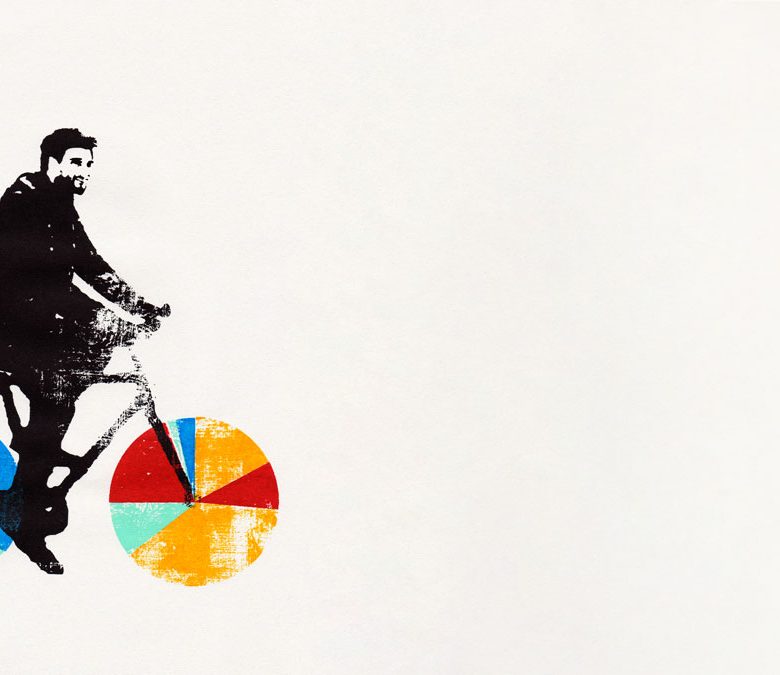
The HiPPO — the term is Avinash Kaushik’s[6] — is the most expensive algorithm in business: senior, confident, and wrong at scale. The antidote is a culture where evidence outranks title.

🍕 Domino’s Pizza, 2009. Their pizza was rated worst in class. Instead of a PR spin (the HiPPO move), they used raw feedback data to reinvent the recipe — and pivoted into “a tech company that sells pizza.” Over the following years Domino’s stock famously outpaced even Amazon’s and Google’s over comparable windows.

When official channels lose to opinions, employees vote with their logins. MIT found a thriving “shadow AI economy”: only about 40% of companies have licensed an enterprise AI subscription, yet employees at over 90% of surveyed organizations regularly use personal AI tools for work.[1] The HiPPO doesn’t stop adoption — it just pushes it off the books, ungoverned and unmeasured.

Insight-to-action latency
0 25 50 75 100 Real-time Daily Weekly Monthly Quarterly Insight-to-action latency Advantage index How fast an insight becomes an action — the compounding edge of short loops. Illustrative.
Decision advantage

How to read this: insight decays like fruit. Winners shorten the distance between learning something and doing something; losers laminate the learning into a quarterly deck.

Vanity (avoid)

  • “1 million registered users” — who never log in.
  • “Total page views” — with zero context.
  • Impressive, cumulative, and useless for decisions.

North Star (chase)

  • “50k weekly active users” — performing the key action.
  • Airbnb’s choice: ignore total visits; measure nights booked.
  • One number the whole company can move.
If a metric can’t change a decision, it’s decoration.Hang fewer, honester numbers on the wall.

There is a subtler trap hiding inside the 95% statistic: many pilots reported “no measurable P&L impact” because nobody set a baseline before launch — the absence of measurement read as the absence of value.[1] The fix is boring and decisive: pick the number, record it before you build, review it after. McKinsey’s 2025 survey lands in the same place — 88% of organizations use AI somewhere, yet only 39% can point to any EBIT impact, and the strongest single correlate of impact is redesigning the workflow around the tool, which only about 21% have done.[2]

Before Target can predict customer behavior, it needs clean, unified purchase history. Losers try to implement AI on top of messy spreadsheets — and then blame the model.

The raw material is getting harder, not easier: industry estimates put 80–90% of enterprise data in unstructured form — documents, images, logs, video — growing far faster than the tidy tables dashboards were built for.[3] And budgets keep aiming at the wrong target: most GenAI spending chases visible sales-and-marketing pilots, while the clearest returns in MIT’s data sat in unglamorous back-office automation.[1]

$1 dollar to verify a record at entry
$10 dollars to fix it later, downstream
$100 dollars when bad data causes a business failure

Governance is not bureaucracy — it is the cheapest accuracy you will ever buy. Verify at the source, or pay a hundredfold at the decision.

03The verdict

Start Monday#

Winning with data isn’t about buying the most expensive warehouse or hiring the most PhDs. It is about humility — being willing to prove your own intuition wrong. Here is what the 5% actually do, distilled from the 2025 research.

1
Baseline before you build.

Record the number you intend to move before touching a tool. “No measurable impact” is usually a missing baseline, not a failed idea.[1]

2
Buy before you build.

Partner-built, workflow-embedded tools succeeded about 67% of the time; internal builds about 33%. Buy the workflow, not the model.[1]

3
Rebuild one workflow end-to-end.

The strongest correlate of AI-driven EBIT impact is workflow redesign — and only about 21% of organizations have done it.[2]

4
Go where the ROI hides.

Budgets chase sales-and-marketing demos; returns cluster in back-office automation. Follow the boring money.[1]

5
Demand systems that learn.

Static tools decay. Winners deploy systems that retain feedback and context — and keep iterating after go-live.[1]

Interactive · 60 seconds
Where does your organization fall?
1 / 4

1
Fix one dataset.

The one every decision depends on. Clean it at the source.

2
Answer one question.

A real one, with a decision attached — not a dashboard ornament.

3
Act on one insight.

Insight-to-action latency is the metric that eats all the others.

The path forward: the data divide is crossed by habits, not purchases. Baseline one number, buy one embedded tool, rebuild one workflow — then repeat until evidence outranking opinion stops being an initiative and starts being the culture.

04Grounding

Sources#

Every number on this page traces to a published study or a documented account. Charts and profiles are illustrative; the claims are not.

  1. MIT NANDA — “The GenAI Divide: State of AI in Business 2025.” MIT Media Lab initiative, July 2025. 300+ public implementations, 52 structured interviews, 153 surveyed leaders: $30–40B spent; ~95% report no measurable P&L impact; 5% of integrated pilots extract millions in value; partner-built succeeds ~67% vs ~33% in-house; the shadow-AI economy; back-office ROI. Read the report
  2. McKinsey & Company — “The State of AI in 2025: Agents, Innovation, and Transformation.” 5 November 2025; 1,993 respondents across 105 countries: 88% use AI regularly; about a third are scaling; 39% report any EBIT impact; ~6% are high performers; workflow redesign is the strongest correlate of impact — and only ~21% have done it. Read the survey
  3. IDC — Worldwide Global DataSphere Forecast, 2024–2028. 149 zettabytes created in 2024, ~181 ZB in 2025, ~394 ZB forecast for 2028; industry estimates put 80–90% of enterprise data in unstructured form. Coverage
  4. IDC & Lenovo — CIO Playbook 2025. Global survey (n=2,920), February 2025: ~88% of AI proofs-of-concept never reach production — four of 33 graduate. The cited causes are organizational readiness, unclear ROI, and data that isn’t AI-ready — not model capability. Claim record
  5. Labovitz & Chang — the 1-10-100 rule. The classic data-quality heuristic: a dollar to verify at entry, ten to correct downstream, a hundred when bad data drives a bad decision.
  6. Avinash Kaushik — on the HiPPO. The “Highest Paid Person’s Opinion” as the default decision algorithm, and the case for letting evidence outrank title. Occam’s Razor
  7. Marc Randolph — “That Will Never Work” (2019). Netflix’s co-founder on the 2000 meeting in Dallas: $50 million, laughed out of the room. Netflix Research
  8. RAND Corporation (2024). On the root causes of AI project failure: more than 80% fail — roughly twice the failure rate of non-AI IT projects.
For companies that would rather be right than data-rich.
Part of the Data Strategy Deep Dive · Updated 6 August 2026. Valuations approximate; profiles illustrative; every statistic sourced above.

Ali Reza Rashidi
Ali Reza Rashidi
Ali Reza Rashidi, a Senior Data Scientist-Gen Al | Al Architect | MLOps with over ten years of experience, He is the author of three books that delve into the world of data and management.

Comments are closed.

error: Content is protected!